
More Than Melting Ice: What’s Really Driving Sea Level Rise in Our Backyard?
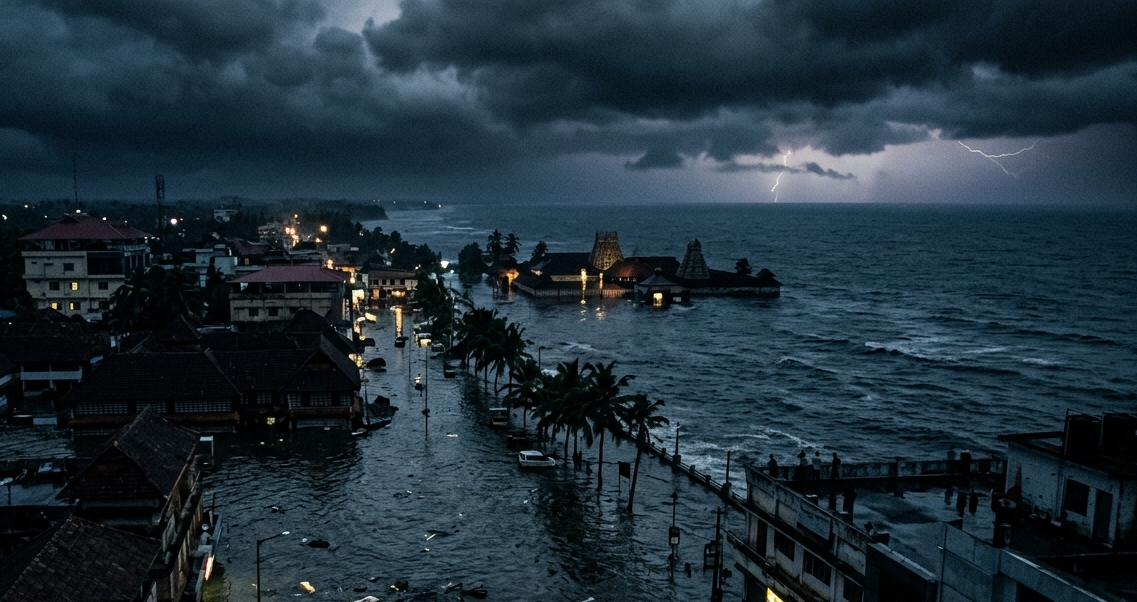
A new study titled “Sub-Basin Sea Level Budget Analysis in the North Indian Ocean (2003–2024)” published in Nature Scientific Reports reveals that the North Indian Ocean (NIO) sea level is rising at an accelerated rate of 4.83 ± 0.22 mm/yr, significantly outpacing the global average of approximately 3.4 mm/yr. Crucially, while global sea level rise is primarily driven by the addition of water mass from melting ice, the NIO represents a uniquely heat-dominated system. Thermal expansion accounts for nearly half of the total regional sea level rise, driven by accelerated ocean warming over recent decades.
The study highlights a high degree of spatial variation across the basin's sub-regions. The Western Bay of Bengal experienced the highest rate of sea level rise at 5.19 ± 0.41 mm/yr, where massive freshwater river runoff lowers salinity and accelerates expansion. In contrast, the Western Arabian Sea saw the lowest rate of rise at 4.29 ± 0.27 mm/yr, where increasing salinity acts as a natural brake that suppresses thermal expansion. In the easternmost equatorial waters, the research identified an anomalous mass-driven rise (>3 mm/yr), pointing to a lingering geological signature related to the crustal adjustments following the 2004 Sumatra-Andaman earthquake.
On year-to-year scales, these sea level variations are heavily modulated by natural climate engines like El Niño/La Niña and the Indian Ocean Dipole, which alter wind patterns and trigger long-period ocean waves across the basin. While this comprehensive budget successfully quantifies the primary steric and mass contributions, a residual gap of roughly 20% (~0.98 mm/yr) remains. Resolving this outstanding uncertainty (integrating coastal land motion, sediment loading, and deep-ocean warming), is the vital next step toward delivering the precise, localized projections needed to protect vulnerable coastal communities across South Asia.
Research team: Mr. Ullas M. Pillai (SRF, NERCI), Dr. Franck Ghomsi (University of Manitoba, Canada), Dr. Ajith Joseph K (NERCI), Dr.Roshin P. Raj (NERSC, Norway), and Prof. Ola M. Johannessen (Nansen Scientific Society, Norway).
The full study can be accessed here: https://doi.org/10.1038/s41598-026-60856-5
For more information, please contact: Dr. Ajith Joseph K
Location
Nansen Environmental Research Centre (India),
Amenity Centre,
Kerala University of Fisheries and Ocean Studies,
Madavana Junction, Panangad P.O,
Kochi-682506., Kerala, INDIA.


25 years in Climate, Ocean & Environmental Research
© 2026 Nansen Centre. All Rights Reserved.
Powered by Mapstrix Solutions
Nansen Research Fellows